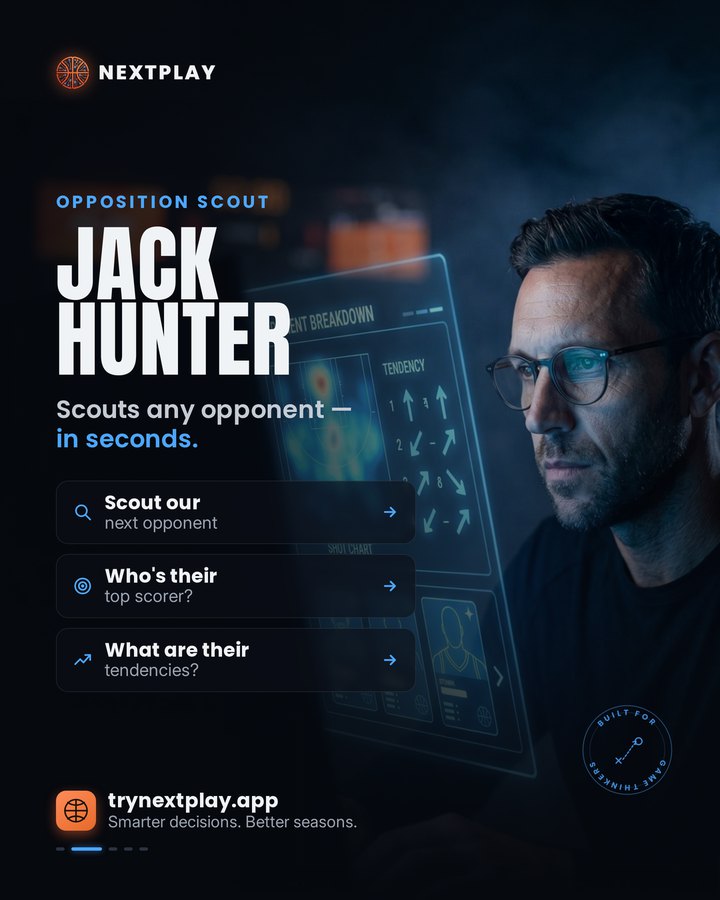
Print-ready scouting report templates you can use tonight - and Jack Hunter, an AI opposition scout who researches your next opponent, cites his sources, and preps the matchup against your actual roster. No analyst. No guesswork sold as data.
14-day free trial with Jack Hunter included · $19/month (or $190/year - 2 months free) after · no credit card
Three print-ready scouting sheets, structured the way Jack Hunter writes his own reports: an opponent team scouting report template, a player scouting report template, and a game-plan + self-scout sheet. Read the structure here, or grab them as PDFs below.
🔍Jack Hunter: "One page. If your players need a binder to remember the game plan, the game plan is wrong. Identity, three names, three keys - that's a scout."
No email needed. The full pack adds the player template and the game-plan sheet.
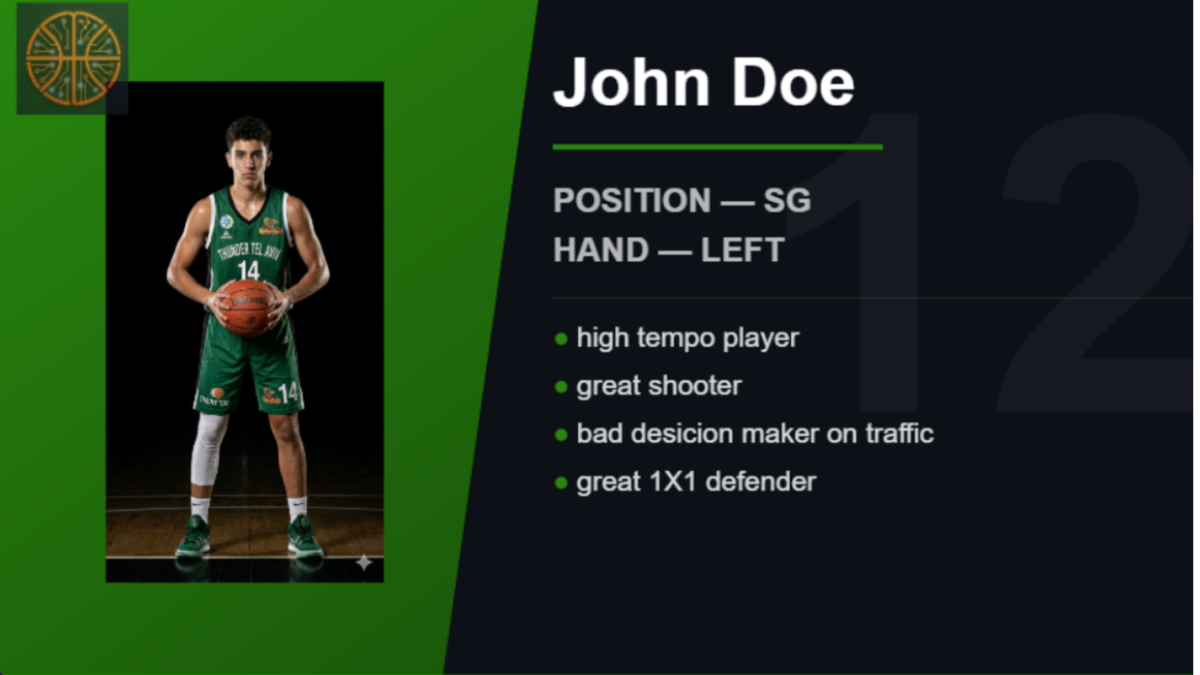
🔍Jack Hunter: "Most teams are one player plus noise. Scout that player properly and you've scouted 60% of their offense. Tendencies, not highlights - which hand, which spots, what he does when the first option dies."
🔍Jack Hunter: "A scout that doesn't change what you do in practice Tuesday is trivia. This sheet closes the loop - their tendencies on the left, your week on the right."
The team template above is free, no email. Want the full pack? Leave your email and get all three - the opponent team report, the player scouting report and the game-plan + self-scout sheet - as designed PDF sheets with Jack's field notes on every section.
You're in - the full pack is unlocked (we emailed you a copy too).
Download All 3 Templates (PDF) ↓No spam - just the templates. Unsubscribe anytime.
These templates are the manual version. Inside NextPlay, Jack Hunter fills them in for you - he researches the opponent, verifies what he finds, and writes the report against your actual roster.
One of the five AI specialists on your NextPlay coaching staff - the one who does the homework on everyone else.
Opposition Scout · AI Coaching Staff
Jack spent his career scouting in European leagues before joining your bench. He reads the game through numbers, scout sheets, box scores and patterns - not hunches. Think detective, not fan: sharp-eyed, a little cynical, and he trusts what the paper trail shows over what anyone tells him.
Ask him about your next opponent and he goes to work: searches the live web, weighs the sources, cross-checks the numbers, and comes back with a structured report - and when the data isn't there, he says so instead of inventing it.
"I don't trust vibes. Show me the sheet."
Searches league sites, stats databases and news on demand - prefers authoritative sources like FIBA, league federations and stats references. Social media is blacklisted.
Reads your roster, player stats, recent games and schedule - so the matchup prep is against your actual personnel, not a generic team.
Every report lists its sources and a confidence rating. A stat is only "high confidence" when two independent sources agree. No data? He says "couldn't verify" - never invents.
Insights from every scout stick to your team's memory. By the rematch, Jack already knows what worked, what didn't, and what changed.
No forms to fill. You ask like you'd ask a human scout - Jack does the legwork.
"Scout Hapoel Ramat-Gan U16 before Friday." Or paste a link to the league standings or a stats page - Jack starts from whatever you give him.
An 8-stage research pipeline: plan the searches, hit the web, triage sources by authority, fetch and extract, then cross-check - two sources must agree before a number is trusted.
Team identity, key personnel with tactical notes, matchup prep for your roster, honest gaps, cited sources and a confidence rating. And he remembers it for the rematch.
The real structure, section by section. (Example data shown for illustration.)
Jack Hunter · Scouting Report
Confidence: High
Transition team that wants the game in the 80s - most of their damage comes in the first 8 seconds of the clock. In the half court they thin out fast: heavy on one ball-screen action, limited counters when it's taken away.
Your press-break is the swing factor: they generate 22% of their offense from steals. Get the ball past half court cleanly and this becomes a half-court game they don't want.
No verified data on their bench rotation beyond 7 players - league site doesn't publish minutes. Watch the first quarter for their sub pattern.
league-federation standings page · regional stats database · local sports coverage - 3 sources, cross-checked
Because a confident guess is worse than no scout at all.
A generic chatbot answers from memory and fills gaps with plausible fiction. Jack runs live web searches for every report, reads the actual pages, and shows you which ones he used.
Two sources must agree before a stat makes the report. What can't be verified goes in the GAPS section - flagged, not faked. Ask a chatbot for a local team's stats and see what it makes up.
The matchup prep is written against your real roster, stats and schedule - and the insights persist, so scouting compounds over the season instead of starting from zero.
On the Pro plan, scouting lives inside your film room: build opponent player profiles, drop scout cards with names, numbers and tendencies straight into your clip timeline, and send the whole session to your players' phones.
If "scouting" currently means watching one grainy video the night before - this is for you.
League publishes standings and box scores? Jack turns them into a game plan.
Opponent report + practice priorities + the film, one workspace before Friday.
Stats-rich leagues are Jack's home turf - deep reports with real numbers.
Jack remembers the first game's scout - the second report starts smarter.
Jack's report feeds straight into the rest of your AI coaching staff: Coach Duncan builds the week's practice around it, the tactician picks the counters, and the Play Creator holds the sets you'll run. One workspace, your team's data.
Full AI coaching staff, all 5 specialists. $19/month, or $190/year (2 months free) after your free trial. Film room + scout cards? Pro at $29/month.
Get the Full Staff Free for 14 Days →A basketball scouting report is a one-or-two-page brief on an upcoming opponent: how they like to play (pace, style, go-to sets), their key players and tendencies, their strengths and vulnerabilities, and what your team should do about it. Good reports turn film and stats into three or four things your players can actually remember on game night.
Yes - the opponent team scouting report template on this page is a free PDF download, no email needed. Leave your email and you get the complete pack: the team template, a player scouting report template, and a game-plan + self-scout sheet, all print-ready.
Start with what's public: league standings, box scores, stats pages and any available film. Identify their pace and style, their top two or three scorers and how they get their points, their preferred sets and press/zone looks, and where they struggle. Then turn it into a short game plan: 3-4 keys your team will actually remember. Our free template walks through each section - or Jack Hunter, NextPlay's AI scout, does the research part for you and writes the report.
Jack Hunter researches the live web on demand - league sites, stats databases and news sources, preferring authoritative domains like FIBA, league federations and stats references. Every report cites the URLs it used and carries a confidence rating; a stat is only marked high-confidence when two independent sources agree. When he can't verify something, the report says so in a GAPS section instead of guessing - he never invents numbers.
No - there are no data-feed integrations. Jack works from what's publicly available on the web, plus your own team's roster, stats and schedule inside NextPlay. If your league publishes box scores or standings online, he can use them; he can also read a specific page you paste a link to.
Honestly: it depends on what's published online. Youth and local leagues with public standings, box scores or team pages scout well - especially if you paste a link to your league's site. For teams with no online footprint, Jack tells you what he couldn't verify instead of making it up, and the free templates let you capture what you see from the bench yourself.
Jack Hunter is included in every NextPlay plan - Basic is $19/month (or $190/year - 2 months free) and includes the full AI coaching staff: scout, tactician, practice planner, analytics and the Play Creator. Every new account starts with a 14-day free trial, no credit card.
Yes - on the Pro plan, the Video Hub lets you build opponent player profiles and scout cards and drop them straight into your film sessions: cut clips of their key players, add a card with the name, number and tendencies, and share the compiled video to your team's phones.
Grab the free templates - or let Jack Hunter do the homework and hand you the report.